
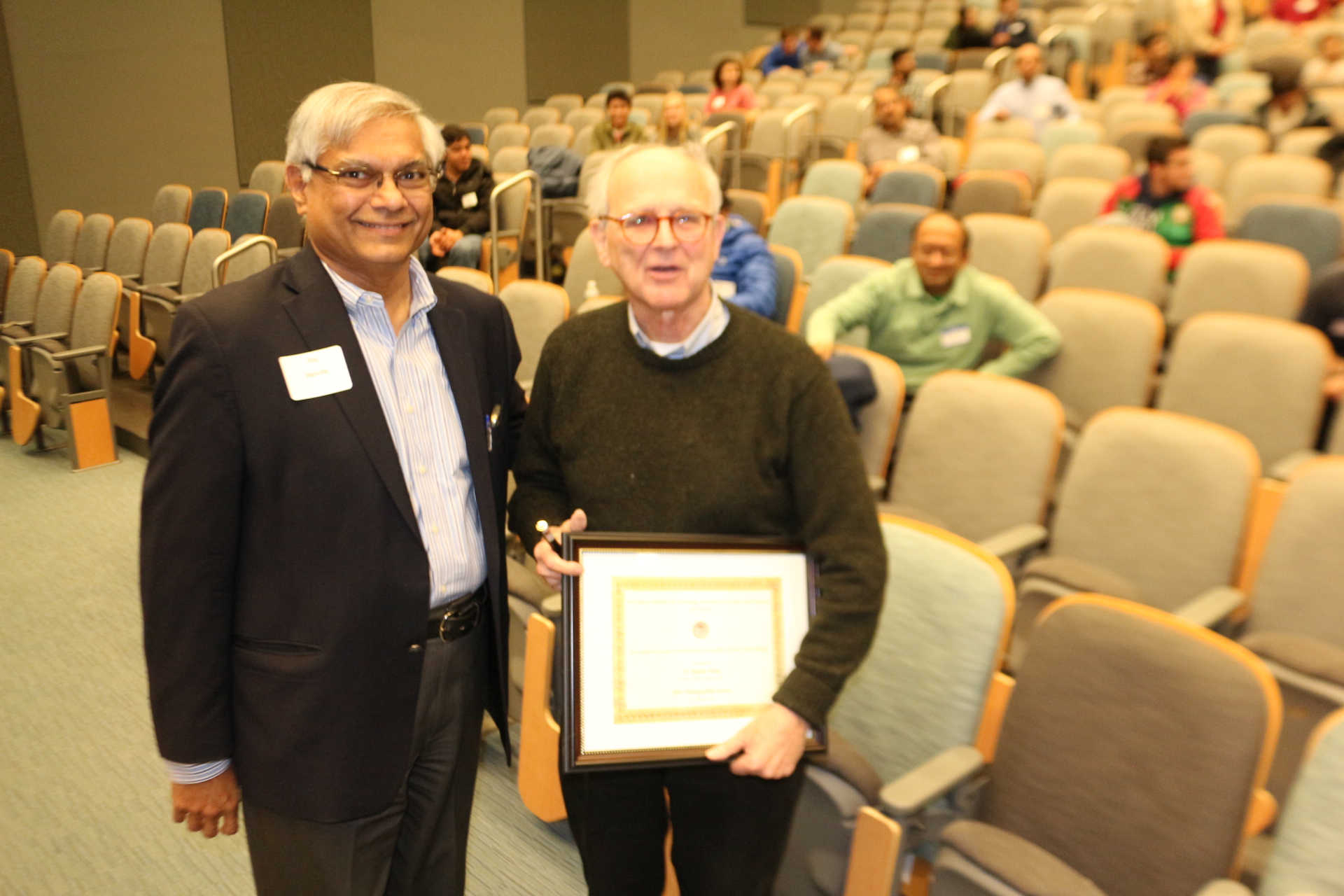
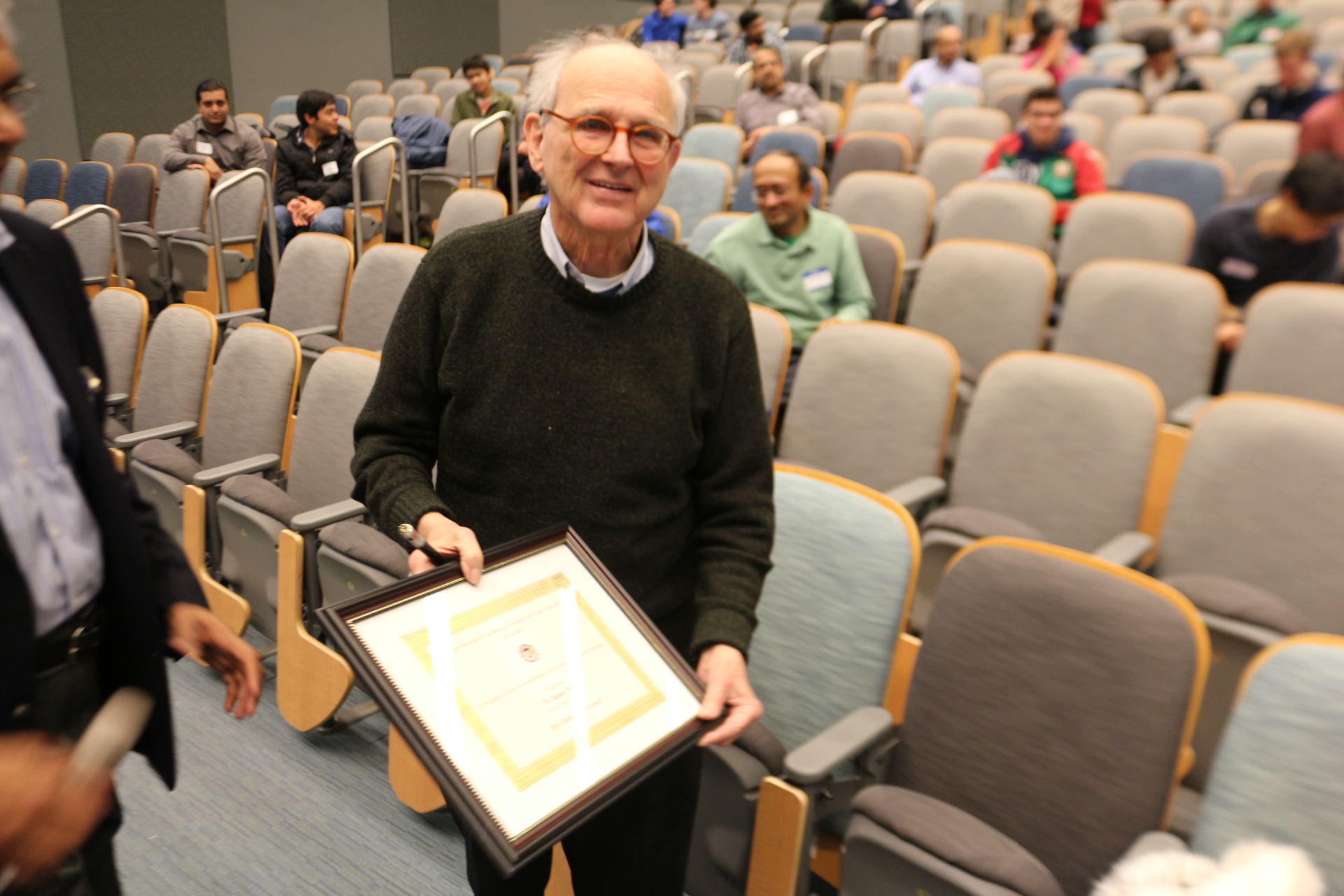
IIT AGNE was honored to have Dr. Rainer Weiss, Professor of Physics Emeritus at MIT to deliver the inaugural lecture as part of the newly announced IIT AGNE Distinguished Lecture Series. Dr. Weiss is an accomplished physicist who has been at the leading edge of cosmic discoveries. He was involved with the first atomic clocks, experiments to detect and quantify the cosmic background radiation and most recently has led the effort to detect gravitational waves using the instrument he invented – the Laser Interferometer Gravitational-Wave Observatory (LIGO). The following is a summary of his talk for those who were unable to attend. A copy of his slides and links to his talk will be available on the IIT AGNE website soon.
Over a hundred years ago, Einstein postulated the existence of gravitational waves as part of his general theory of relativity. Einstein’s theory upended centuries of scientific thought grounded in Newton’s laws of gravity. Einstein’s approach suggested that masses interacted due to the bending of space-time. As a byproduct, even the path of light was affected by gravitational effects from massive objects. This lensing effect was confirmed in 1919 through observations of the solar eclipse. In addition, Einstein suggested that the interaction due to gravity could not happen instantaneously but would be effected through gravitational waves. Empirical observations helped confirm the existence of gravitational waves by observing the orbital decay of a neutron binary system. However directly observing the phenomena proved to be elusive.

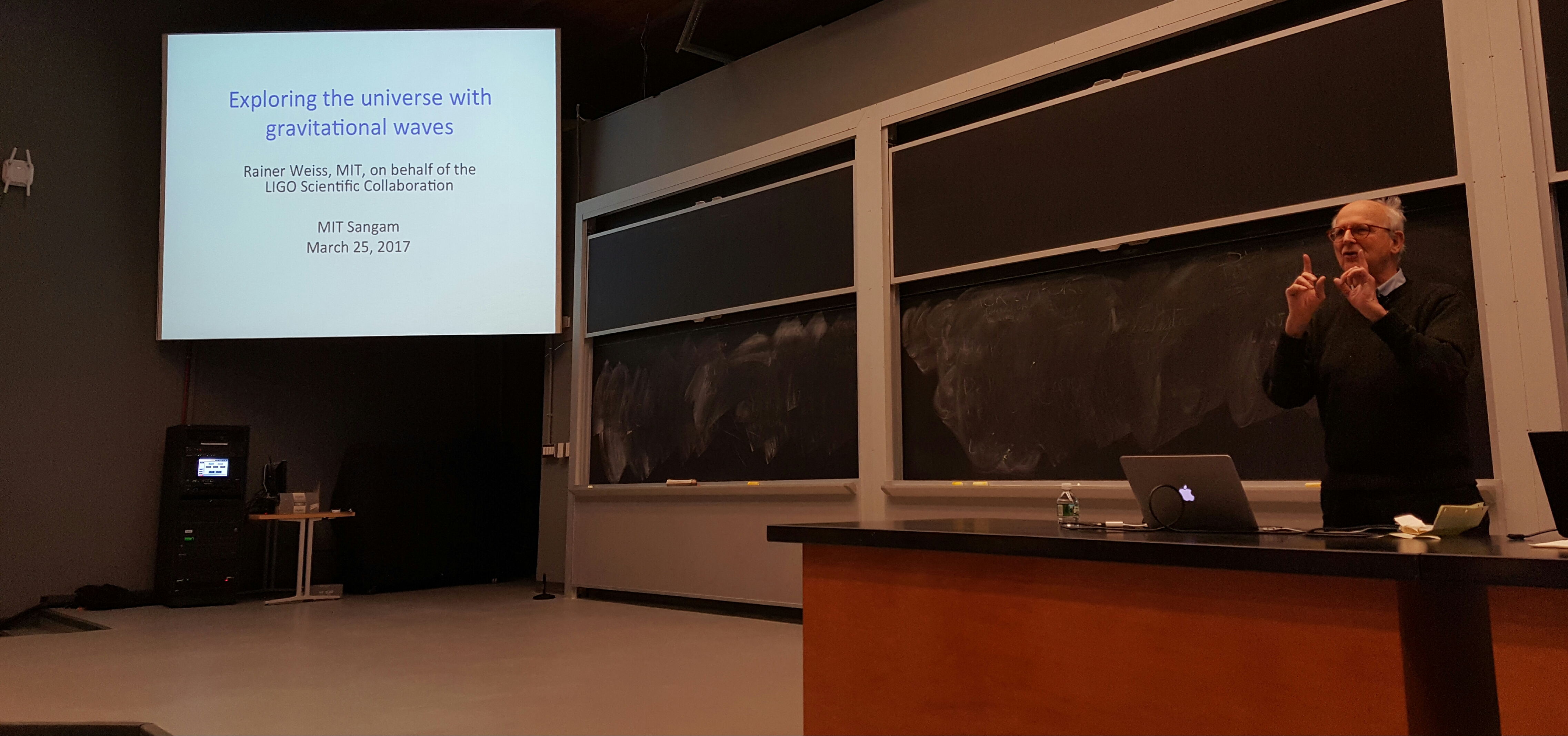
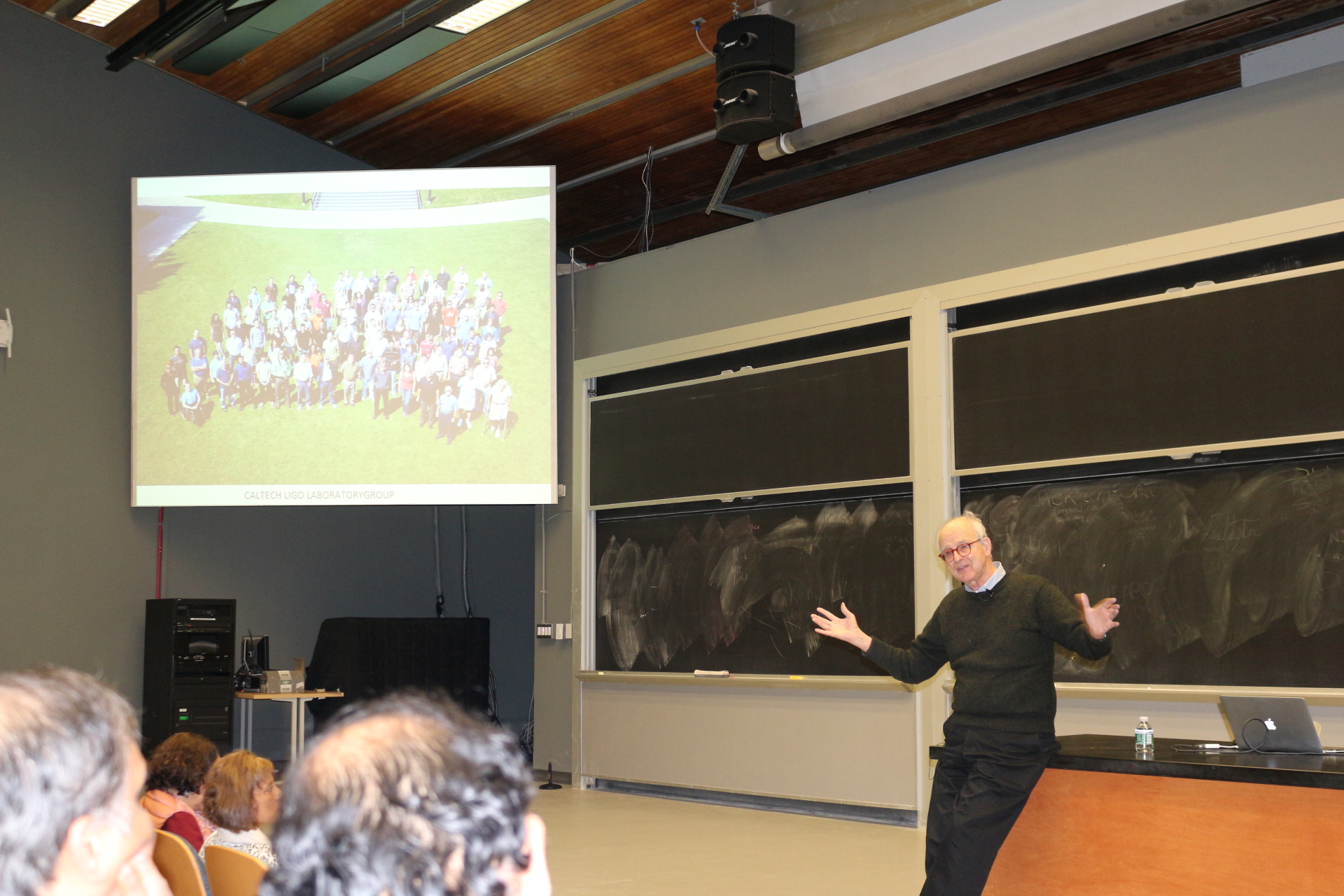
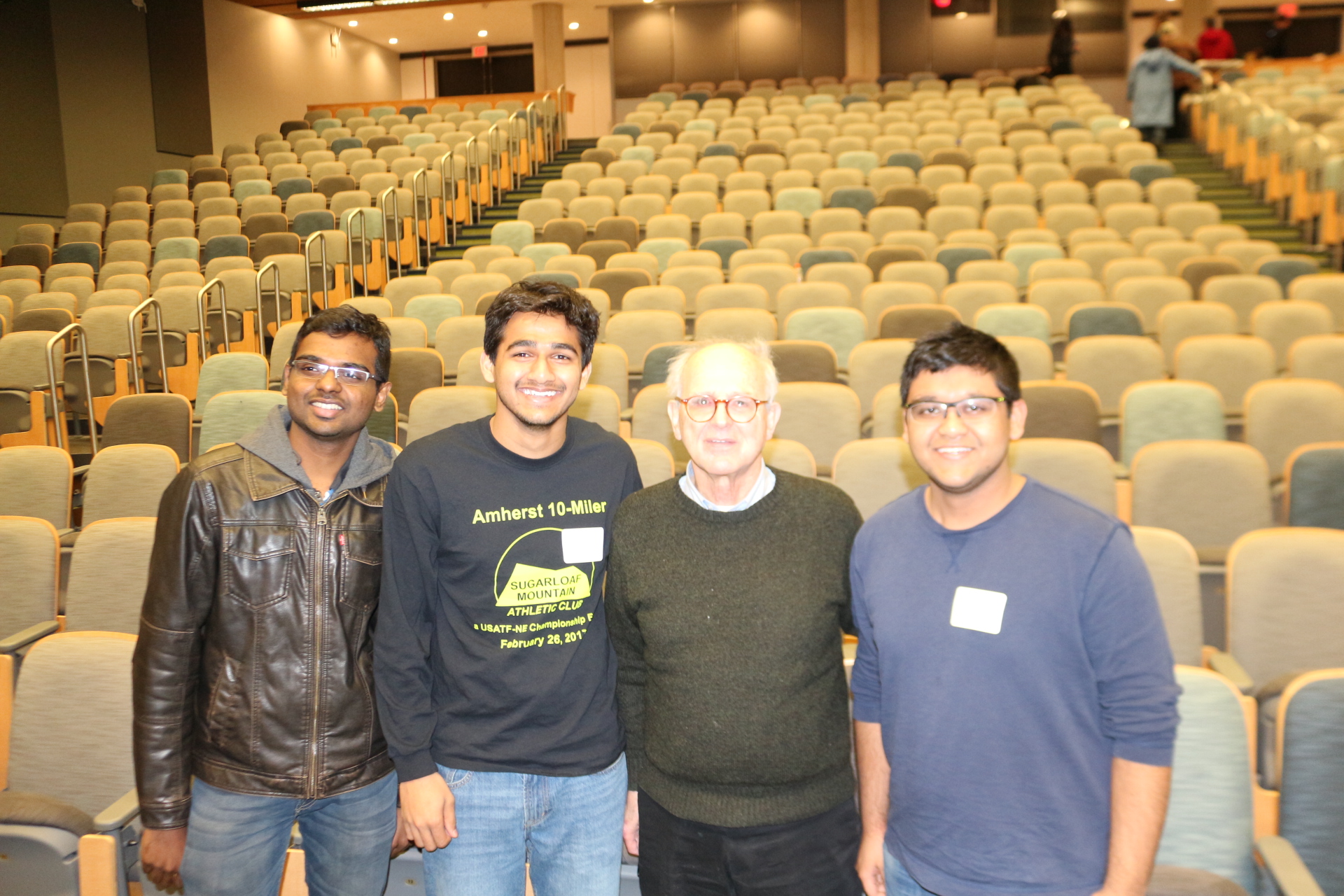
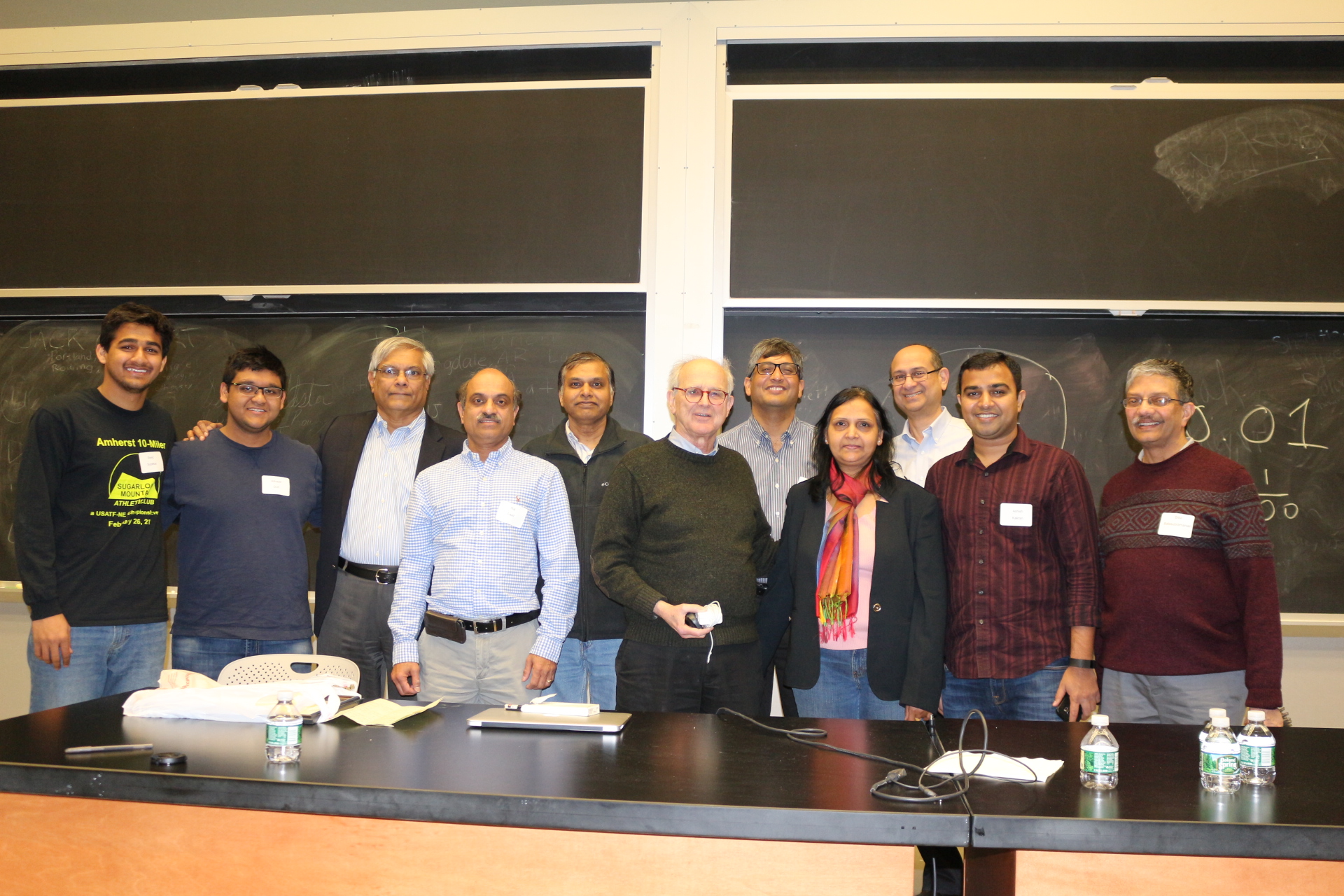
In 1967, as a young professor at MIT, Rainer Weiss was asked to teach a course on general relativity. In an attempt to make the concepts more practical, he described a simple experiment that could potentially detect gravitational waves. His invention which would later become the Laser Interferometer Gravitational-Wave Observatory (LIGO) consisted of splitting a laser beam down two orthogonal arms, bouncing them back off mirrors at the ends and reflecting them back to a photodetector. Any slight variation in the mirrors position would be detected by an out of phase shift between the two reflected waves.
While simple in theory, the challenges to implement the instrument were daunting. To measure perturbations caused by gravitational waves, requires the instrument to detect changes in length one thousandth of the width of an atomic nucleus. Each arm of the interferometer had to be 4 kilometers long and had to enclose a vacuum tube at near absolute vacuum. Since the changes being detected were so small, latent vibrations from seismic or thermal noise had to be isolated and damped. The engineering behind the entire apparatus took nearly twenty years to complete and required the cooperation of over 80 institutions and 1000+ scientists.
Finally, on September 14, 2015 the detectors at the two LIGO sites in Livingston, Louisiana and Hanford, Washington both detected a slight chirp that was triggered by a gravitational wave generated by two colliding black holes a billion light years away. It took some time for scientists to verify the data but soon the LIGO Sites were detecting many such occurrences on a regular basis.
Plans for additional LIGO sites are now progressing that will help provide better location and detection capabilities. In India, several institutions are part of the LIGO Scientific Collaboration. The government of India has also committed to developing a LIGO site in the country and the Indigo consortium, consisting of several Indian scientific institutions including IIT Gandhinagar and IIT Madras, are working on the site plans. Prof. Weiss noted that there are several openings for interested scientists and technologists for that effort. More information may be found at http://www.gw-indigo.org
