


IIT AGNE sponsored and conducted an event on the future of clean energy technologies on December 9th, 2015 at the Anderson Auditorium at Tufts University. This was the second event in a series leading up to the Leadership Conference 2016 organized by IIT AGNE, with the theme “Leading transformation for a better tomorrow: Technologies that lift the human spirit”.
This event featured three experts talking about solar, batteries and lighting: Vivek Soni, a leading cleantech venture advisor at Boston Cleantech Partners; Makarand “Chips” Chipalkatti, a pioneer in the area of LED lighting and Suresh Sriramulu, veteran technology development leader in battery technologies.
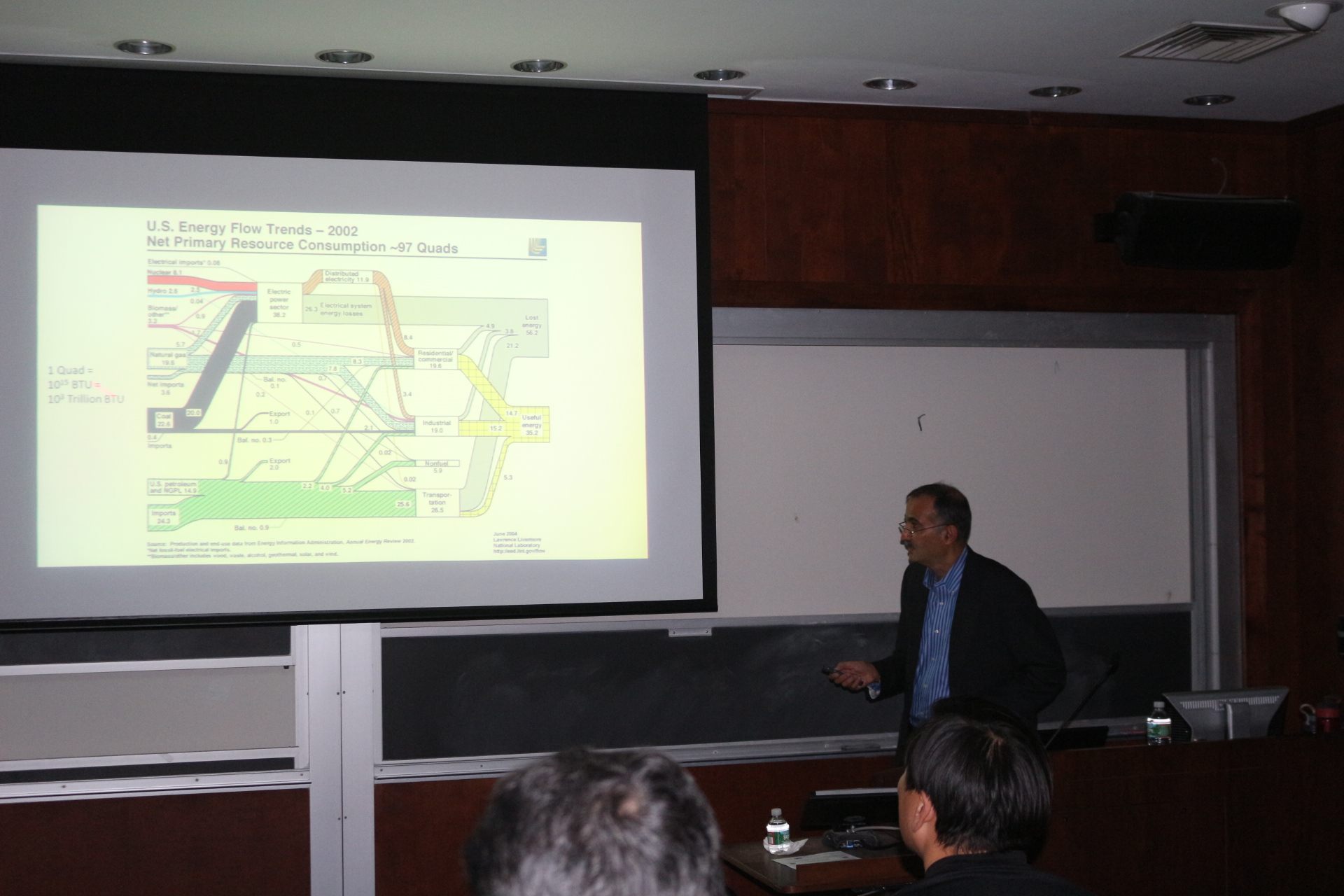
Vivek Soni, currently a Venture Advisor at Boston Cleantech Partners, started with a broad description of the energy and water usage is used in the United States, the impact on climate change and where technology can have a very large impact. Using Energy Flow diagrams published by the Lawrence Livermore National Laboratory, Vivek highlighted the fact that the total amount of energy used by the United States has not changed significantly in the past twenty years, the energy use per capita has decreased and overall CO2 emissions by the United States have actually decreased significantly (by roughly 7%). This is due to massive investments in and deployment of clean technologies, including solar, wind and geothermal technologies; as well a significant reduction in coal plants use for energy generation and pollution control and switching to natural gas for electricity generation.
However, this will not be sufficient to forestall the effects of climate change, as developing countries rapidly industrialize and increase their carbon emissions. As evidenced by 2015, which has been one of the warmest years in more than a century, climate change is happening, as global temperatures keep pace with increasing CO2 concentrations, which are at their highest levels in the Earth’s history over the past million years.
While the USA and the European countries, which have the highest per capita emissions, are expected to continually decrease their annual emissions, the rest of the world will continually increase their carbon emissions. In particular, India and China have doubled and tripled their per-capita carbon emissions, respectively, in the past twenty five years. Vivek gave the example of Indonesia, where a massive peat fire has released more greenhouse gases than Germany does in a year. Air pollution due to particulate emissions has made cities like Beijing and Delhi the most hazardous to human health in the world.
Hence concerted global action is urgently needed to reduce greenhouse emissions, reduce pollution and limit the severe effects of climate change, which include monster hurricanes, submergence of low lying areas and killer heat waves. The historic COP21 conference, held in December 2015, had 192 countries that have pledged action that is estimated to limit global temperature rise to 3oC (not the target of 2oC). These countries, which account for 90% of global emissions, have also agreed to make annual investments, estimated at 100 billion US dollars, needed to reduce per capita emissions from the developing world.
Vivek then outlined the technologies needed to limit greenhouse gases (GHG) and meet the target temperature rise. According to McKinsey’s global GHG abatement model, a number of clean technologies have significant potential to provide net abatement at a modest or negative cost i.e. the benefits exceed the investment costs incurred. He mentioned that Goldman Sachs has recently identified “low-carbon” technologies with the greatest economic impact potential as Solar Photovoltaics, On-shore Wind, LED lighting, Hybrid/Electric Vehicles and Energy Storage.
All of these can produce economic growth and create jobs, while having a strong impact on climate change. Solar photovoltaics (PV) has been a major success cleantech success story, globally and in the United States, as mature technologies, manufacturing at scale, government policies and innovative financing have created incentives for manufacturing producers, installers and consumers. The installed cost of a PV cell has dropped precipitously by 80% or more in the period 2000-2015, leading to an average growth rate of 55% for US residential installations, which now number more than a million.
Solar photovoltaics (PV) have created almost 2.5 million jobs in 2014 in the United States. There are more than 36,000 solar systems installed in Massachusetts alone, with almost 1 GW capacity installed in 2015 at a cost of $ 600 million, creating more solar jobs than even in a sunny state like Arizona. The picture is getting brighter as it is expected that the number of solar installations in Massachusetts will double by the summer 2016. It is expected that by 2020, residential installations will account for almost half of all solar installed capacity in the United States, estimated to be 15 Gigawatts power.
This set the stage for “Chips” Chipalkatti of Dr. Chips Consulting LLC, to talk about LED lighting, which is the next big low-carbon technology. Chips, a renowned LED expert who pioneered the LED lighting business while at Osram Sylvania, now consults with governments, non-profits and private sector entrepreneurs across the world.
LED lighting is an energy-efficient, durable and long-life lighting solution that has unique attributes to make an impact on climate change. Like Solar PV, LEDs have plummeted in cost by 10-20% each year and have become more efficient, producing 20-40 times more light (lumens/W) compared to standard incandescent bulbs.
LEDs are also a compact, solid state electronics, multi-colored technology that can be used to create unique intelligent lighting solutions. A simple change to LED lights in all US homes by 2020 can lead to 15% savings in energy use, and 40% savings by 2030, (equivalent of taking 35 million vehicles off the road), adopting intelligent LED lighting systems can potentially save additional 28% more in energy usage. This becomes significant when extended to the rest of the world, especially populous countries that produce large amounts of carbon emissions.
The LED lighting ecosystem extends to new materials, intelligent sensing and controls, communication, seamless integration with architecture and smart grids. LED lights can be made in numerous form factors and colors to create personalized smart lighting schemes that can convey information and change color to match the time of the day or night. LED lighting is playing a big role in the coming Internet of Things (IoT) revolution, when lights can be integrated with or attached to any object, worn on clothing or even ingested. Additionally, since LEDs are a solid state technology, there are opportunities to make them even more environmentally friendly at end of product life by remanufacturing new LED lights from old, thus avoiding filling up landfills and wasting the energy used to make them.
LEDs have the potential to transform lives in developing countries, where 2 billion people or 1/4th of the world’s population still lives without electricity, with the largest number in India and Africa, with 125 million households in India and 105 million households. In these regions, kerosene is frequently used at night for lighting, which is inefficient, expensive and produces large carbon emissions.
LEDs can be combined with batteries and solar technologies in an off-grid solution to bring light to remote and under-developed areas and reduce emissions. Chips described his work on a unique project in Africa for lighting on fishing boats around Lake Victoria, where the fishermen effectively buy a small portion of electricity by renting batteries and LED light from an energy hub.
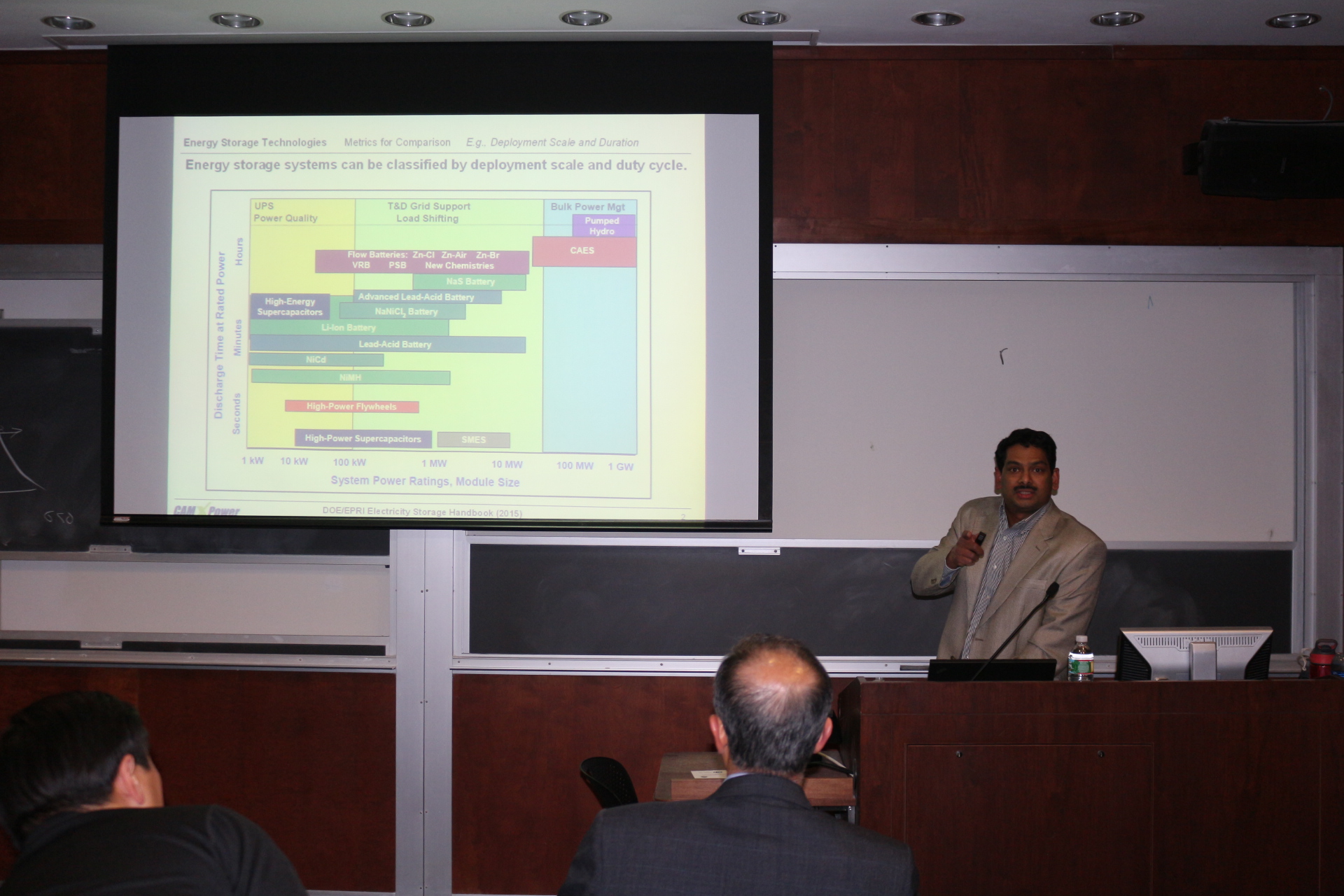
Finally Suresh Sriramulu, CTO of CAMX Power, spoke about the impact of energy storage technologies, and specifically batteries on climate change. Energy storage is critical for the implementation of low-carbon technologies in enabling the deployment of renewable sources of energy as well as reducing CO2 emissions from vehicles. Batteries are ideal for shifting loads from day to night and provide high quality consistent power when hybridized with renewable energy sources. By enabling reduced consumption of fossil fuels, batteries also enable reduction of CO2 emissions from automobiles.
Like Solar PV and LED lighting, batteries for enabling low-carbon technologies are well on their way to commercialization and widespread adoption. Several re-chargeable battery technologies with a wide range of performance characteristics are being developed today or already in use. For example, NiMH (Nickel Metal Hydride) and Lithium-Ion batteries are already being widely used in consumer electronics applications, but are also attractive for electric/hybrid vehicles as compact and light battery packs.
Since vehicles are a primary source of GHG emissions and pollution, vehicle mileage and emissions standards are getting more stringent around the world. These stringent regulations can only be ultimately be met by a large scale shift to electric vehicles (xEVs). Automakers are responding by commercializing vehicles with different levels of electrification enabled by batteries. A typical light-duty vehicle with an internal combustion engine, outputs ~ 200+ grams of carbon dioxide per km driven. This can be reduced to ~ 80g/km by hybridizing with batteries in a so called start-stop or microhybrid configuration. In contrast a plug-in hybrid vehicle or PHEV effectively outputs 50 g CO2/km, and an all-electric vehicle or EV has zero CO2 emissions because the batteries on board the vehicle can be charged by electricity from the grid.
Because rechargeable batteries based on Li-ion technology has been used for other applications with a well-developed supply chain and manufacturing maturity, their adaptation for vehicle applications has been rapid. Consequently, first generation xEV vehicles using Li-ion battery technology such as Tesla vehicles, Nissan Leaf and Chevy Volt are already on the road today.
As a result, Hybrid/Electric vehicle sales are forecasted to increase by roughly ten times over the next ten years, though it will be small in number compared to the IC engine driven vehicles. Although one of the limitations for widespread deployment of xEVs has been the additional vehicle cost associated with the on board Li-ion battery, it is forecast that vehicle battery costs will be halved by 2020 with the development of dedicated battery plants for automobile use such as the Tesla Gigafactory.
To drive further widespread adoption, innovations are needed in government policies, new technologies for increasing battery energy density and enhancing battery safety, leasing/financing models and in infrastructure.